🌿 Plant Profile
Name: Giant Groundsel (Dendrosenecio kilimanjari). Origin/Class: Native to the high-altitude regions of Mount Kilimanjaro in Tanzania. This extraordinary species belongs to the Asteraceae family, demonstrating how a seemingly ordinary plant can transform into a massive entity under the right conditions.
🌵 Distinctive Features
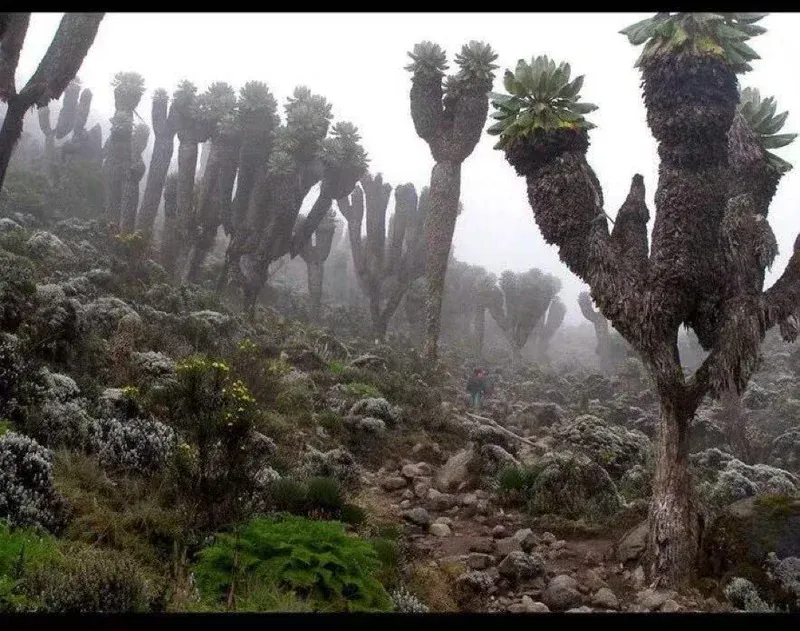
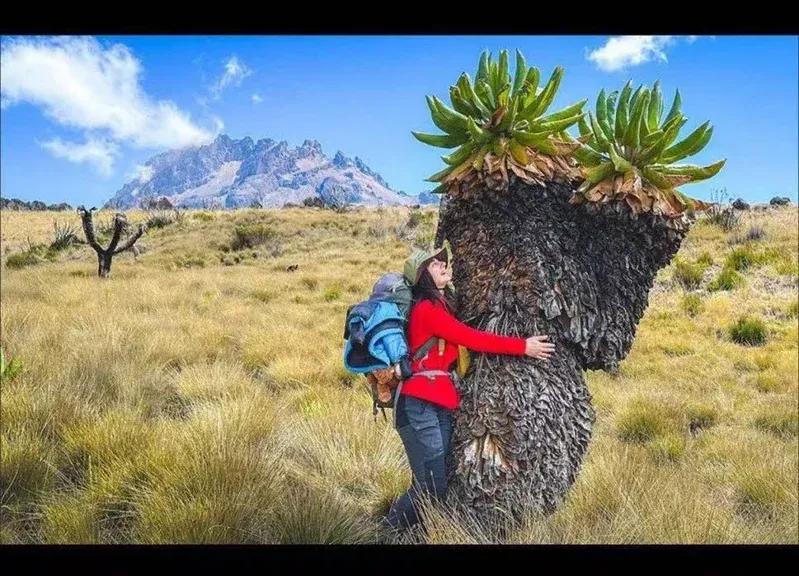
Encountering the Giant Groundsel is like stepping into a science fiction landscape. With its robust, woody trunk and a large, cabbage-like rosette of fleshy leaves, it resembles a fusion of a cactus, a palm, and a pineapple. The plant’s signature feature is its “Shag Carpet” of aged leaves. Unlike typical trees that discard their old foliage, the Giant Groundsel retains it, causing the leaves to drape downward and create a thick, insulating layer. This “fur coat” may appear unkempt, but it’s a masterstroke of evolutionary design for survival.
📖 The Evolutionary Journey
The saga of the Giant Groundsel is one of “Evolutionary Isolation.” Millions of years ago, seeds from the common groundsel were transported by wind or birds to the lofty peaks of East Africa. In these isolated “Sky Islands,” the plants confronted a unique climate conundrum: “Summer by day, Winter by night.” At elevations of 14,000 feet (about 4,200 meters), the sun blazes fiercely during the day, while nighttime temperatures plunge below freezing. To adapt, the plant developed gigantism to store water and a unique insulating system. The sheath of dead leaves safeguards the plant’s internal systems from freezing, making it a living relic amidst the misty highlands where few other organisms can endure.
🌱 Cultivation and Growth
🐢 Life’s First Steps: The Slow Ascent Cultivating a Giant Groundsel requires patience. These plants grow at a sluggish pace, often only 1-2 inches (3-5 cm) annually. A towering specimen today might have begun its journey when wooden sailing ships still traversed the oceans. It spends its initial decade forming a ground-level rosette before aspiring skyward.
🐢 Environment: The Alpine Enigma
- Cultivation Difficulty: Among the most challenging plants to cultivate away from its natural habitat, it requires not only cold temperatures but also diurnal temperature swings. It thrives on intense UV exposure during the day and freezing conditions at night—an environment rarely replicated in conventional greenhouses.
- The “Dormant” Phase: By night, the living rosette leaves curl inward, enveloping the tender growth tip in a bud-like formation to shield it from frost. This behavior, known as nyctinasty, is a survival mechanism.
🐢 Botanical Exploration: A Sight to Behold The Giant Groundsel isn’t suited for a backyard garden; it’s a journey for the Bucket List. To witness these giants in their full splendor, one must trek along the Machame or Lemosho trails of Kilimanjaro, where they emerge from the misty “Afro-Alpine” zone as silent sentinels.
🌼 Lessons from the Plant
In a society that often encourages shedding the past, the Giant Groundsel imparts the lesson of “Honoring Our Heritage.” Retaining its dead leaves—its history—protects its essence. It serves as a poignant reminder that our past experiences, battles, and “old layers” are not mere burdens; they are the blanket that warms our spirits when the world becomes harsh.